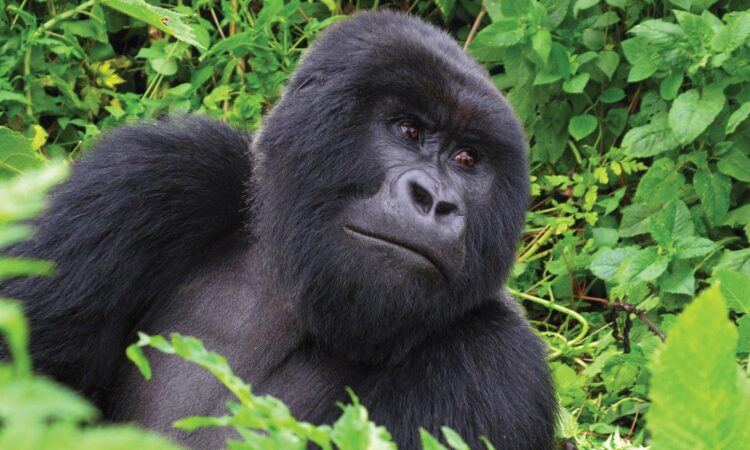

Mountain gorilla behavior is rather wide and complex thus exhausting them presents a challenge. Gorillas, currently the most powerful of the apes could be mistaken as dangerous creatures. The adult males reach up to the height of 1,7m which is 6ft and weigh up to 140 to 275kg. Females, however, 40-50% smaller compared to the males. More powerful males pose the ability to tear a branch from a tree and uproot small trees.
Location of mountain gorillas in Uganda.
Mountain gorillas only live in the forested mountainous regions of Uganda. The areas of Bwindi and Mgahinga National Park specifically offer them habitats. Tracking them offers the best way to meet them in their natural habitat. Both national parks are located in the south western part of Uganda, yet characterized by very cold conditions. This results from their location within thick vegetation cover.
Bwindi National Park has four regions in which gorilla families have been habituated and can be found for trekking tours. These include Ruhija, Buhoma, Nkuringo and Rushaga gorilla sectors.
Social structure of gorillas.
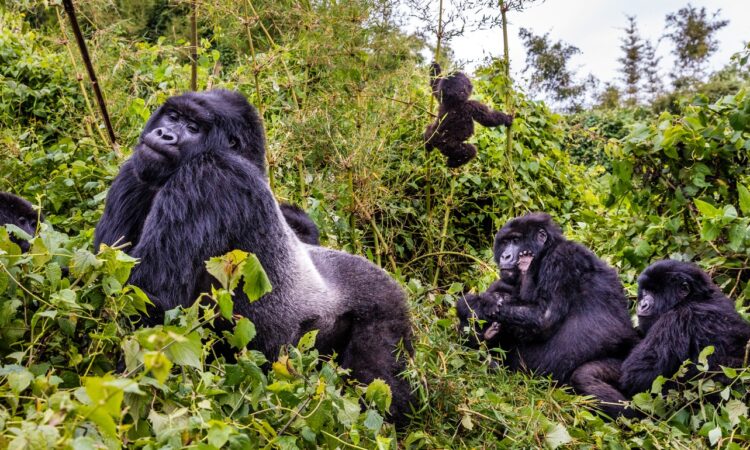
Mount gorillas are non-territorial type of animals that live in groups known as troops or families. Each group has one or more adult male known as silverbacks and these can be 1-4 in number. In a troop, juvenile males (black backs) plus a number of adult females as well as baby gorillas exist. Normally, the oldest and strongest silverback is the most dominant in the family. This makes him assume the right to breed with any adult female.
At around the age of 8, adolescent female moves or transfers to another gorilla family before it reproduces. When it joins a new troop and reproduces, the family becomes its permanent residence. Female rank within a family is always determined by the order to which its recruitment happened. Therefore, adolescent females prefer to join a lone silverback or a newly formed family rather than a long established one.
An adolescent male moves away from its family due to lack of breeding and leadership opportunities. By choice, he remains single until joined by other females to form its own independent gorilla family. This period takes several years. First, the juvenile male separates gradually from its parent troop. The distance of separation increases as the days go by.
Population within a gorilla family usually ranges between 2 to 12 individuals. The largest troop ever identified had 4 silverbacks, 5 black backs, 12 adults and 16 young ones. On average, 9 individuals live in a troop. A troop with more than one silverback implies that the rest might be sons of the dominant one. The distance of their homes is between 4km² to 25km².
Social behaviors of Mountain gorillas.
Dominant silverback makes all the decisions with in the family. Also, he must defend the family from any kind of danger or rivals. This comes from those silverbacks who wish to establish their own troops or to add on their troops. He eats the biggest portion of food, even in times of scarcity. Adult females struggle to stay close to the dominant silverback Sometimes, they fight each other to keep close to him. Adult female gorillas bond strongly with their off spring for the first three years after birth. Gorillas greet each other by nose to nose.
Daily activities of mountain gorillas.
Gorillas divide their 24 hours in such a way that, feeding and resting is done on a daily basis. They move distances of between 400-1000 meters daily which is about 88-219 miles per year. They construct new nests on ground each day, to sleep every end of the day. This is due to their frequent change in location in search of food and provisions.
Individual behaviors.
Mountain gorillas walk four footed with limited movements. Gorillas and chimpanzees have distinct walking styles known as knuckle walking. Their weight makes them unable to walk long distances in search for food. Gorillas don’t share or compete for food and it’s on rare occasions when they do. Female gorillas have a gestation period of 257 days which is 8.5 months. It’s always difficult to tell a pregnant gorilla since her stomach is always large even when she is not.
Where to stay when you visit Mountain gorillas in Uganda?
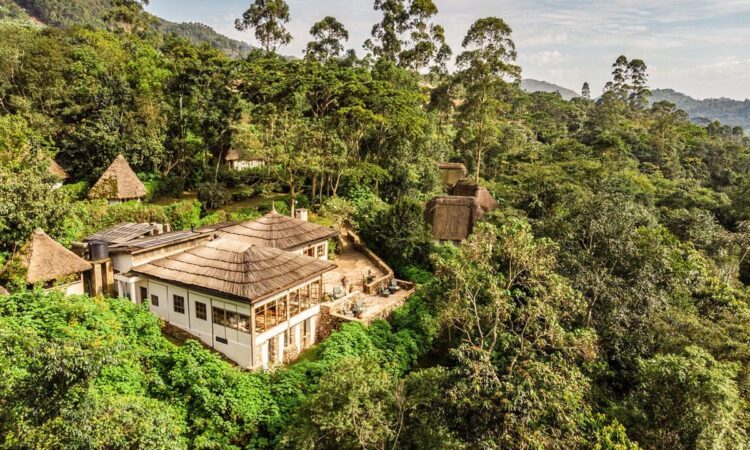
The numerous different accommodation places such as hotels range from luxury, mid-range to budget hotels. These may include Clouds mountain gorilla lodge, Four Gorillas Lodge and Buhoma Lodge for luxury. Ichumbi gorilla lodge, Agandi eco lodge and Haven lodge Buhoma for mid-range. Finally, Buhoma Guesthouse, Broadbill forest camp and Rushaga Gorilla Havens lodge offer budget services.
How to get to Bwindi and Mgahinga Gorilla National parks?
From Entebbe airport, by road it’s an 8 hours’ drive to Bwindi and Mgahinga Gorilla National Parks. While by air, one can fly from Entebbe airstrip to Kisoro or Kihiihi airstrips. They offer the best sites for private planes to land near Mgahinga and Bwindi Impenetrable National Park respectively.
When is the best time to visit mountain gorillas?
Trekking gorillas in their natural home is an all year experience. But the best time to visit is the dry season; between January-February and June-September. This offers a less difficult gorilla trekking tour yet with clear views of the gorillas.